


How to Analyze a Stock Systematically
Most retail investors do not struggle because information is unavailable. They struggle because they assume more information automatically creates better decisions.
One day the process starts with a chart. The next day it starts with a valuation multiple. Then it turns into a pile of notes, screenshots, earnings-call excerpts, and half-remembered arguments about whether the company is “cheap” or “high quality.” That can feel like research, but it often produces a weak decision process because fragmented thinking starts masquerading as depth. The order of analysis is unclear, the standard of evidence keeps moving, and the final judgment becomes harder to revisit later.
A systematic stock analysis process does not eliminate uncertainty. It does something more realistic and more valuable: it improves how you think through uncertainty. It gives you a repeatable sequence for deciding what matters, how to weigh evidence, what to compare, and what would change your mind.
This article walks through that sequence. It is not a recipe for finding instant winners, and it is not a promise that one checklist can fit every company. It is a practical framework for serious retail investors who want to analyze stocks with more discipline and less noise. If you want a more accessible first-pass version of the same job, How Do You Analyze a Stock as a Beginner is the most natural starting point.
What a systematic stock analysis process is actually for
A systematic process is not the same as a rigid formula. In investing, rigid formulas can create false certainty because different businesses deserve different questions, different time horizons, and different risk standards. A software company with high gross margins and recurring revenue should not be evaluated exactly the same way as a cyclical manufacturer, a bank, or a commodity-linked business.
It is also not the same as being busy. That is one of the most common investor mistakes. People often treat research intensity as a proxy for research quality. They read more, track more, and watch more, then assume the decision must be improving. Often it is not. Often the process is just becoming harder to audit. If that pattern feels familiar, Common Stock Analysis Mistakes is a useful companion because it breaks down the process failures that often look like serious work on the surface.
What a system should do is make your thinking more consistent in four ways:
- It should help you ask the right first questions before you get lost in details.
- It should keep evidence organized by role, not just by volume.
- It should help you compare opportunities using a stable standard.
- It should make your reasoning reviewable later, so you can see where you were right, early, incomplete, or wrong.
That matters because bad stock decisions are often not caused by one catastrophic mistake. They are caused by small process failures repeated over time. You started with an interesting idea but never defined the actual decision. You noticed a cheap valuation but skipped the business-quality questions. You liked the story, then interpreted every new fact as confirmation. Or you built a thesis once and could not reconstruct it six months later when the situation changed.
A strong process does not make you infallible. It makes you easier to correct. That is the real insight. The goal is not to become perfectly certain. The goal is to become less vulnerable to your own inconsistency.
Step 1: Define the decision before you collect facts
Many investors start analysis too late in the sequence. They begin by gathering facts without first defining what decision the analysis is supposed to support.
That matters because “analyze this stock” is too broad. Are you trying to decide whether the company deserves a full research cycle? Whether it belongs on a watchlist? Whether it is stronger than another candidate? Whether the thesis still holds after new information? The right depth depends on the job.
If the decision is vague, the research usually becomes vague too. You read more than you need, jump between unrelated data points, and end up with a body of information that feels large but does not answer the question that matters.
A better approach is to start with a small decision statement such as:
- I am deciding whether this company deserves a full research pass.
- I am deciding whether this stock is stronger than two alternatives in the same role.
- I am deciding whether the original thesis still holds after new results.
- I am deciding whether the risk profile fits my standards, even if the upside case looks attractive.
This immediately changes the quality of the work. It tells you what level of analysis is necessary, which comparisons matter, and what kind of conclusion would actually be useful.
It also prevents a common problem in retail investing: treating every new stock idea as if it deserves unlimited attention. It does not. A disciplined process allocates attention in proportion to the decision being made.
Step 2: Build the framework before you collect the facts
Once the decision is clear, the next job is to choose the framework you are going to use. This is where many investors go wrong. They think they are being open-minded by looking at “everything,” but in practice that often means they are weighting information inconsistently.
Before you start collecting facts, decide what categories of evidence matter most for this business and this decision. A useful stock analysis framework usually covers at least these dimensions:
- business quality
- growth durability
- financial strength
- capital allocation
- valuation
- risk and disconfirming factors
That does not mean each dimension matters equally in every case. Some businesses are primarily about durability and reinvestment quality. Others are mainly about cyclical recovery, balance-sheet resilience, or whether the market is overreacting to a temporary issue. The point is not to force equal weighting. The point is to avoid mixing facts without a structure for interpretation.
If you need a deeper explanation of what makes a framework usable in the first place, What Makes a Good Stock Analysis Framework? is the natural companion piece to this article. The short version is that a good framework makes tradeoffs visible. It tells you what you are evaluating and why, rather than letting the loudest or newest data point dominate.
This step is also where you decide what would count as meaningful evidence. For example:
- What would make this business stronger than it appears on the surface?
- What would make the valuation attractive but still not investable?
- What would count as thesis-confirming evidence versus mere interesting detail?
- Which risks are structural and which are temporary?
Without these questions, facts tend to arrive as disconnected fragments. With them, the facts start to organize themselves around a decision.
Step 3: Understand the business before you judge the stock
After the framework is in place, the next step is not valuation. It is understanding the business.
That sounds obvious, but it is frequently skipped or rushed. Many investors can list metrics they care about, yet still struggle to explain in plain language how the company makes money, why customers choose it, what makes its economics durable or fragile, and what conditions would weaken the entire case.
A useful business-understanding pass should answer questions like:
- What does the company actually sell?
- Who pays for it, and why?
- What makes demand durable or vulnerable?
- What does the cost structure look like?
- Is the business capital-light or capital-intensive?
- What kind of competitive pressure is most relevant?
- What makes this business easier or harder to understand than peers?
This is where the analysis starts to become real. If you cannot explain the business simply, you will usually misread the rest of the evidence. Financial strength will look more convincing than it is. Growth will seem more durable than it is. Valuation will feel more attractive than it is.
The goal here is not to become an industry historian. It is to build the minimum level of operating understanding necessary to interpret the numbers correctly. A high-margin software business, a distributor, and a cyclical industrial company can all look attractive on a single metric while meaning very different things in practice. The same margin expansion, for example, can mean better product economics in one company and unsustainably favorable conditions in another.
Consider a simple real-world contrast. Costco and a commodity-linked producer can both report strong recent results, but the process for interpreting those results should be different. Costco’s analysis usually centers on customer retention, pricing discipline, renewal behavior, and operating consistency. A commodity producer may show impressive near-term earnings because the cycle is favorable, even if that says less about durable competitive strength. If you apply one uniform standard to both, you risk confusing temporary favorable conditions with repeatable quality. A systematic process protects you by forcing you to ask what kind of business you are dealing with before you decide what the numbers mean.
This is also the stage where serious investors start separating story quality from business quality. A business can have a compelling story and still be hard to analyze, hard to predict, or structurally weak. A systematic process forces you to ask whether you understand the operating engine before you move deeper into the stock case.
Step 4: Test whether the financial profile supports the business story
Once you understand the business model, the financial profile has context. That changes the quality of the analysis immediately.
Instead of asking, “Are these numbers good?” you can ask better questions:
- Do the numbers support the business story I think I understand?
- Are growth, margins, cash generation, and capital intensity moving in a coherent direction?
- Which parts of the reported performance are durable and which may be temporary?
- Is the balance sheet helping the business stay resilient or making the thesis more fragile?
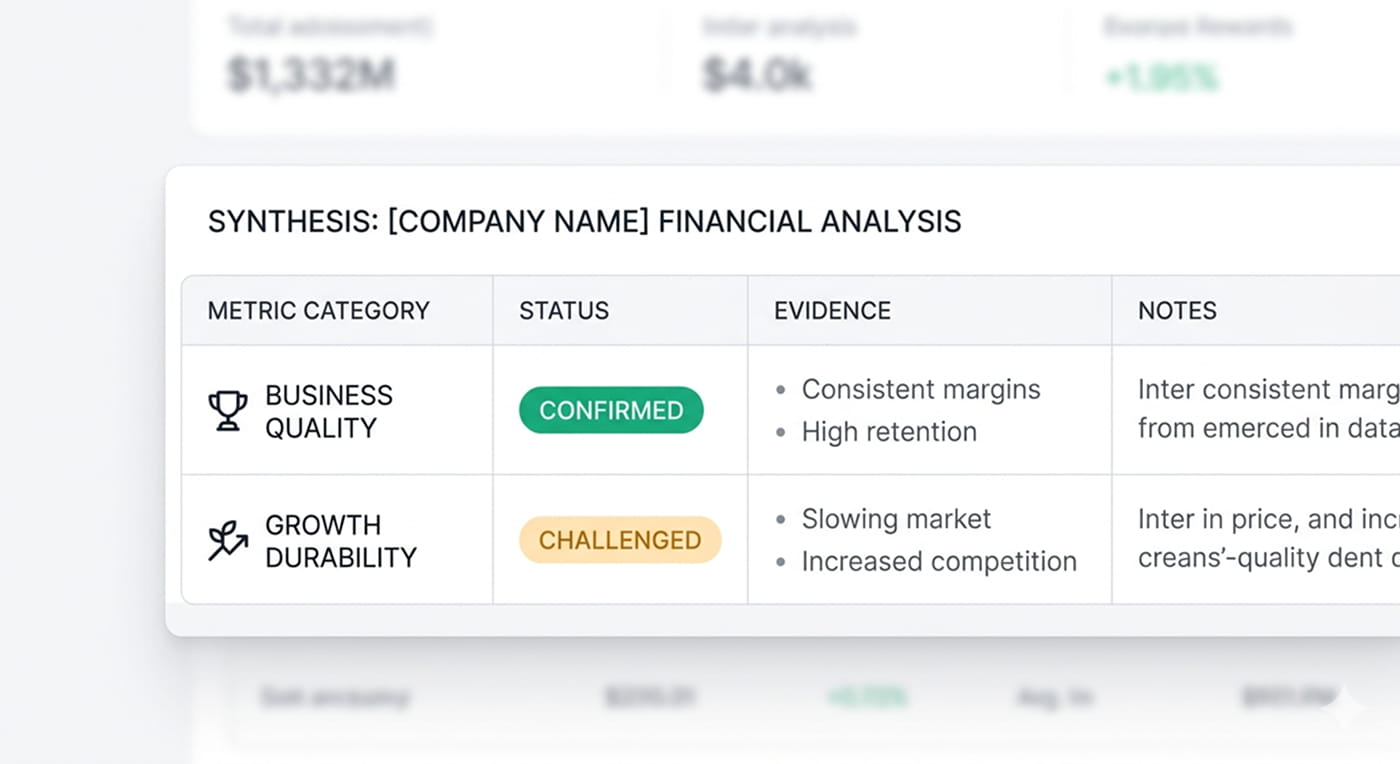
This is where many investors fall into ratio collection. They gather a long list of metrics but do not know which ones deserve emphasis. That is why it helps to keep asking what job each metric performs. Revenue growth might tell you about demand, but not necessarily about quality. Margin expansion might tell you about operating leverage, but not whether the business is becoming more durable. Cash conversion might reveal discipline, but only in the context of working capital, reinvestment needs, and the economic reality of the business.
If you want a deeper breakdown of how to weigh the right evidence, Which Signals Matter Most When Evaluating a Company? is a useful next read. The main principle here is that numbers should either confirm, refine, or challenge the operating story. If they do none of those things, you are probably measuring activity without improving judgment.
For serious retail investors, this stage is especially important because it prevents narrative drift. It is easy to keep liking a company if the story feels intelligent. It is harder to keep liking it when the financial profile is not supporting the supposed strengths. A systematic process makes that confrontation unavoidable, which is exactly what makes it useful.
Step 5: Judge quality and risk before you obsess over valuation
Valuation matters. But valuation without quality analysis can create a false sense of rigor.
A stock can look cheap for a good reason. It can also look expensive while still being the stronger decision if the business quality, durability, and downside profile are materially better than the alternatives. That is why a strong stock analysis process asks quality and risk questions before turning valuation into the headline.
This is the point where you should evaluate:
- durability of demand
- competitive resilience
- reinvestment opportunities
- capital allocation quality
- sensitivity to external conditions
- balance-sheet pressure
- dependence on a few customers, products, or favorable assumptions
This is also where you start thinking in scenarios rather than point estimates. What does the case look like if the company performs roughly as expected? What if execution is good but industry conditions deteriorate? What if the business is fine but capital intensity or leverage limits flexibility? You do not need a false precision model for every scenario, but you do need enough structure to see whether the upside case is dominating your attention.
The key discipline here is to avoid treating valuation as a shortcut around business quality. Cheapness is not the same as opportunity. It is often just a signal that more explanation is required.

Step 6: Compare the stock against realistic alternatives
One of the easiest ways to improve stock decisions is to stop analyzing ideas in isolation.
A stock is rarely competing only against “buy” and “do not buy.” It is competing against other candidates, against waiting, and against the possibility that the current evidence is not strong enough yet. A systematic process makes comparison a core step rather than an afterthought.
That comparison does not need to be overengineered, but it does need to be explicit. For each candidate, ask:
- Which business is easier to understand?
- Which has the cleaner financial profile?
- Which risk profile is easier to live with?
- Which depends on more favorable assumptions?
- Which offers the better balance of upside, downside, and confidence?
This is where many investors discover that the issue was not a bad stock idea. The issue was a weak relative choice. A decent company can still be the wrong decision if a clearer or stronger opportunity exists nearby. One overlooked benefit of comparison is that it exposes when you like a narrative more than you trust the evidence. Comparison forces standards to stay stable across multiple candidates, which is much harder to fake than conviction in a single idea.
If this is a weak point in your current process, Example: Growth vs Value Stock Comparison shows how different analytical lenses can change the way you compare stocks in practice. The broader lesson is simple: comparison improves judgment because it forces your standards to stay stable across multiple options.
Step 7: Write the thesis in a form you can revisit later
At this point, many investors feel they have “done the work” and move straight to a conclusion. That is a missed opportunity. If the reasoning is not captured clearly, the process remains weaker than it appears.
A useful stock thesis does not need to be long. It needs to be reviewable. It should answer:
- What is the case in plain language?
- What are the two or three strongest reasons the stock is attractive?
- What must be true for the thesis to work?
- What evidence would challenge or weaken the case?
- What would make this opportunity less attractive than the alternatives?
This does two important things. First, it forces you to convert scattered impressions into an explicit argument. Second, it gives future-you something concrete to revisit. That matters because investing decisions are often weakened not at the moment of entry, but during the months that follow, when memory becomes selective and reasoning gets rewritten after the fact.
If you want a clearer explanation of that part of the process, What Is a Stock Thesis is the natural companion to this section. The key point here is that a thesis is not a slogan. It is a structured summary of what you believe, why you believe it, and what would make that belief less credible.
Step 8: Define what would change your mind
Strong analysis is not only about building conviction. It is also about defining what would weaken conviction.
This is where process starts protecting you from your own attachment to the idea. If you do not decide in advance what would challenge the case, you are far more likely to reinterpret negative evidence later as noise, temporary pain, or something to “watch.”
A disciplined process should identify:
- the key assumptions behind the thesis
- the operational or financial evidence that would break those assumptions
- the time horizon over which you expect the thesis to prove itself
- the signals that matter enough to trigger a review
That does not mean every negative quarter breaks the thesis. It means you know what kind of change actually matters. Maybe the issue is not one disappointing result, but evidence that pricing power is weaker than believed. Maybe the problem is not slower growth, but capital needs becoming structurally heavier. Maybe the concern is not volatility, but increasing complexity that makes the business harder to judge honestly.
This discipline is what separates a repeatable process from one that gradually becomes narrative maintenance.
Step 9: Turn one-off analysis into a repeatable workflow
This is where many individual investors lose the benefit of their own effort.
They may do a thoughtful first-pass analysis, but the work remains trapped inside scattered documents, browser tabs, screenshots, and mental shorthand. When they revisit the idea, they are forced to rebuild context from scratch. That wastes time, but more importantly, it weakens continuity. The process becomes less cumulative and more episodic.
That is one reason Why Scattered Stock Research Leads to Worse Decisions belongs next to this article in the launch cluster. A structured investing process is not only about what questions you ask. It is also about whether your analysis remains usable over time. If you want the process itself broken into a more reusable operating sequence, A Step-by-Step Stock Research Process extends that workflow view directly.
In practical terms, repeatability means preserving:
- the framework you used
- the evidence you considered most important
- the core thesis
- the disconfirming conditions
- the comparison set
- the next review triggers
When those pieces remain connected, your process gets stronger with repetition. When they do not, each new analysis becomes another isolated event.
This is also where a structured tool can help honestly. If your workflow currently lives across spreadsheets, notes apps, disconnected data tools, and manually reconstructed context, the friction itself starts degrading decision quality. StockGeniuses is designed around that exact problem: supporting structured stock analysis through multiple lenses, explainable evaluation context, and a calmer research workflow. It does not replace investor judgment, and it does not guarantee outcomes. What it can do is make disciplined analysis easier to maintain consistently.
That kind of product relevance is earned here because it is tied directly to the page job. The article has already delivered value on its own. The product mention simply connects that value to a real workflow problem the platform is built to help with.
A simple way to put this process into practice
If you want to make this article useful immediately, start with a simple operating sequence the next time a stock idea appears:
- Define the decision you are making.
- Choose the framework you will use.
- Write a short business explanation in plain language.
- Review the financial profile in the context of that business.
- Assess quality and risk before treating valuation as decisive.
- Compare the stock with at least one realistic alternative.
- Write the thesis and the conditions that would weaken it.
- Save the reasoning in a form you can revisit.
That may sound basic, but the value is in the order. It stops you from jumping straight to the most emotionally attractive part of the analysis. It slows down weak conviction and strengthens usable conviction. If you want a lighter execution version you can use quickly, Stock Analysis Checklist for Retail Investors is the most direct companion. And if you want to see the same sequence applied end to end, Example: How to Analyze a Stock Step-by-Step gives that practical demonstration.
If your current research process feels messy, it is usually not because you lack intelligence or effort. It is because the workflow itself is not helping you think clearly enough. A systematic process fixes that at the right level: not by promising certainty, but by making your reasoning more consistent, comparable, and reviewable.
Final thoughts
Learning how to analyze a stock systematically is not about becoming mechanical. It is about becoming deliberate.
A good process gives you better questions, better comparisons, better records, and better opportunities to correct yourself. That is what serious retail investors need most. Not louder opinions. Not faster reactions. Not more data without structure.
If you can build a workflow that helps you understand the business, test the evidence, compare alternatives, and revisit your own reasoning honestly, you are already operating at a much higher level than the average stock researcher. And if your current setup makes that harder than it should be, that is a workflow problem worth solving directly.