
Methodology built around evidence, context, and investor judgment.
StockGeniuses helps equity investors examine stocks and portfolios using established investing logic, real data, and plain-English AI interpretation. The evidence is organized to support judgment, while the final conclusion remains with the investor.
A consistent way to think under uncertainty.
Investing rarely offers certainty. What it can offer is a repeatable way to gather evidence, compare perspectives, record assumptions, and revisit them as conditions change.
StockGeniuses organizes that work across stock analysis, portfolio context, signals, and decision history—keeping the evidence and the conclusion visible at the same time.
Repeatable analysis
Investing models, transparent metrics, and consistent calculations create a stable foundation for comparison.
Plain-English interpretation
AI translates model outputs, summarizes visible information, and surfaces important tradeoffs.
Investor judgment
The thesis, risks, confidence, and conditions for changing course remain in the investor’s hands.
The principles behind the platform.
A small set of principles guides both the methodology and the way the product is built. They help keep the analysis understandable, the workflow focused, and the investor in control.
Before a feature becomes part of StockGeniuses, it should answer four questions:
Process over predictions
Sound decisions usually come from consistent habits: examining the evidence, recording the thesis, following what changes, and returning later to evaluate the original thinking.
Models before opinions
Analysis begins with established investing frameworks, transparent metrics, and consistent calculations. Interpretation comes after the evidence has been organized.
Context over isolated indicators
A metric becomes more useful when it can be read alongside the company, thesis, portfolio exposure, signal history, and earlier decisions.
AI as interpreter, not authority
AI translates model results, connects visible information, and surfaces tradeoffs. Judgment and action remain with the investor.
Signals prompt review, not action
A signal brings attention to a meaningful change. Its purpose is to reopen the question, giving the investor time to examine whether the thesis has changed.
Descriptive, not prescriptive
StockGeniuses describes what the data and models reveal. The investor decides how that information fits into the broader conclusion.
The investing loop: discover, analyze, decide, track, reflect, improve.
The workflow follows the life of an investment idea—from the first screen to the later review—so what happens at one stage can inform the next.
Discover
Narrow the market to companies worth a closer look using screening and strategy filters.
Analyze
Compare a company across value, growth, income, momentum, financial health, sentiment, and business quality.
Decide
Record the thesis, risks, confidence, and invalidation points while the reasoning is still fresh.
Track
Follow holdings, watchlists, signals, and timelines as new information arrives.
Reflect
Compare the original thesis with what unfolded, separating the quality of the process from the market outcome.
Improve
Use recurring patterns in earlier decisions to sharpen the next round of research.
Each product surface has a clear role.
Each major area of StockGeniuses supports a distinct part of the investing workflow. Stock Analysis, Portfolio, Home, and History & Journal complement one another without duplicating the same job.
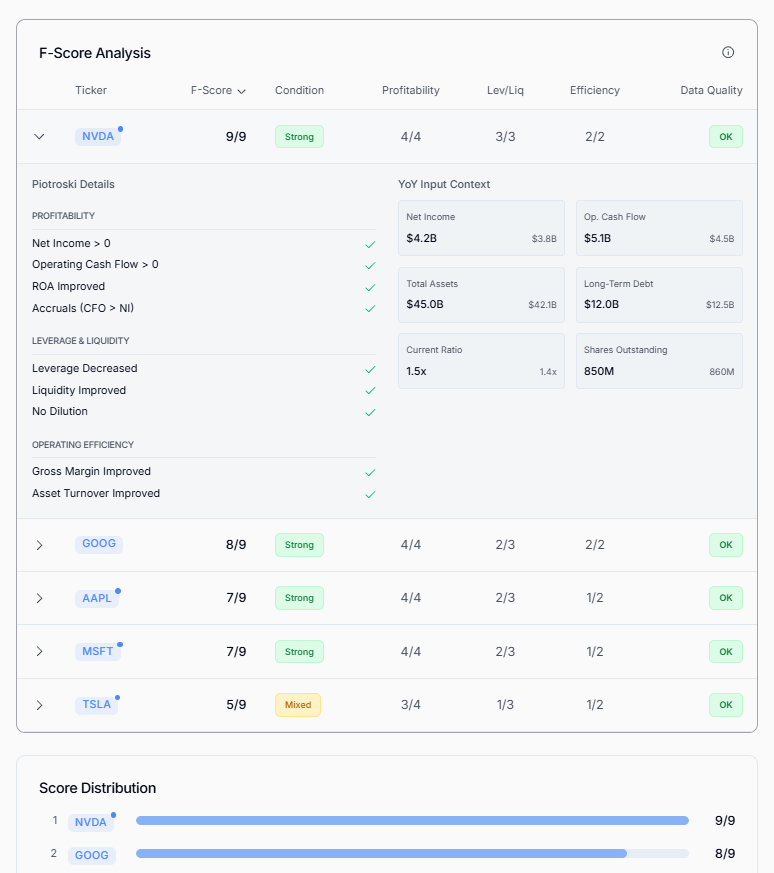
Stock Analysis
Brings investing models, company context, interpretation, and decision history together around one ticker.
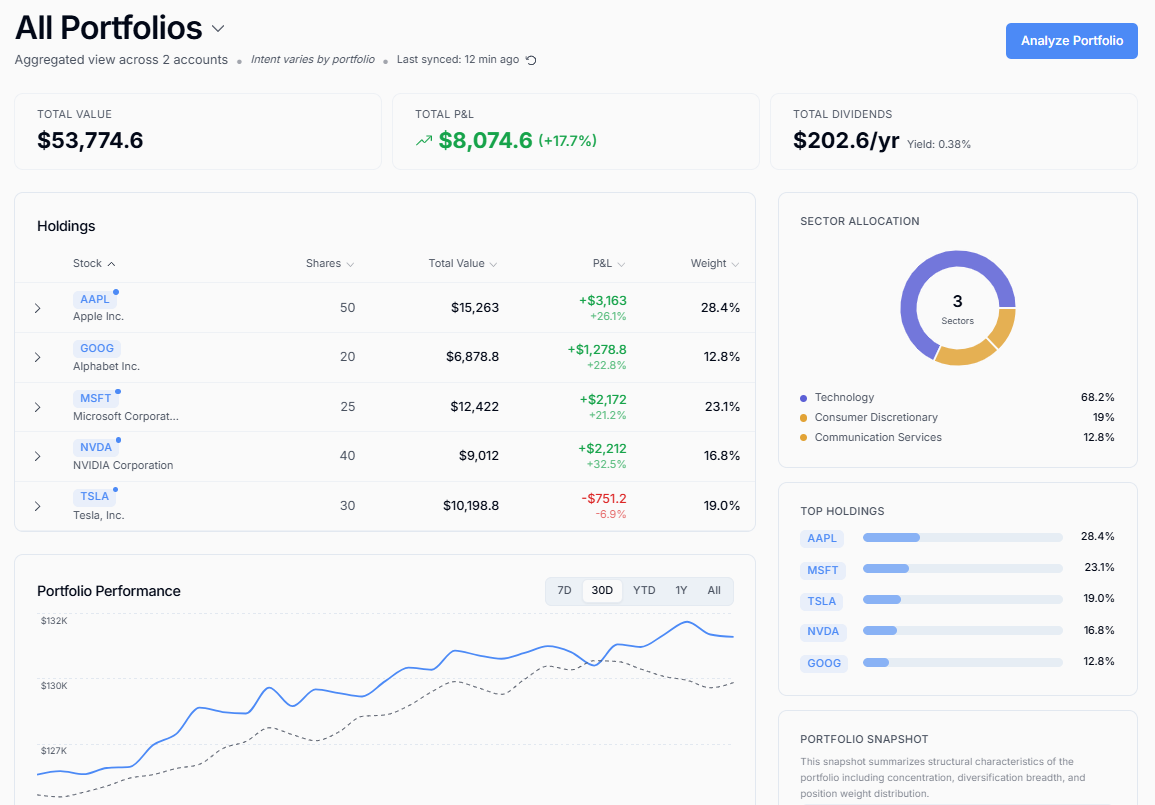
Portfolio
Shows how holdings behave together through exposure, concentration, risk, and alignment with the portfolio’s stated purpose.
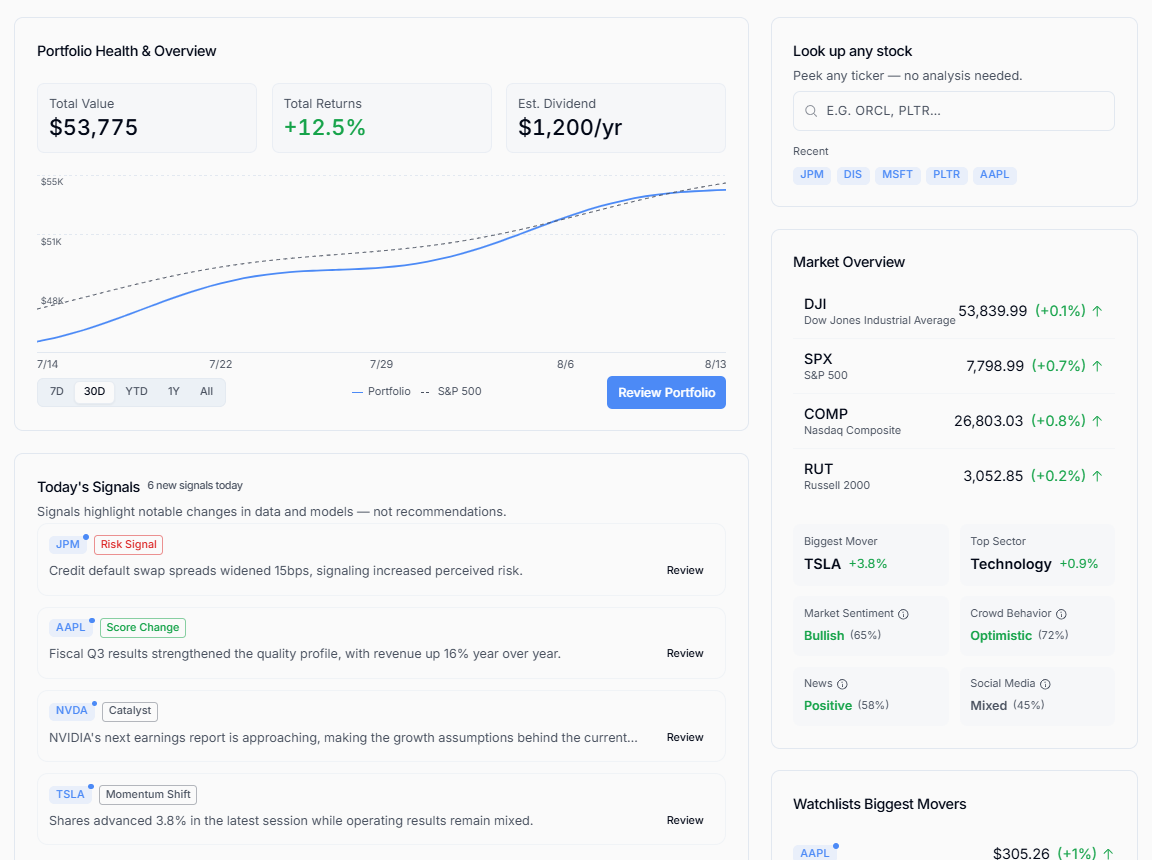
Home Dashboard
Surfaces important changes, signals, and review prompts without overwhelming the workspace.
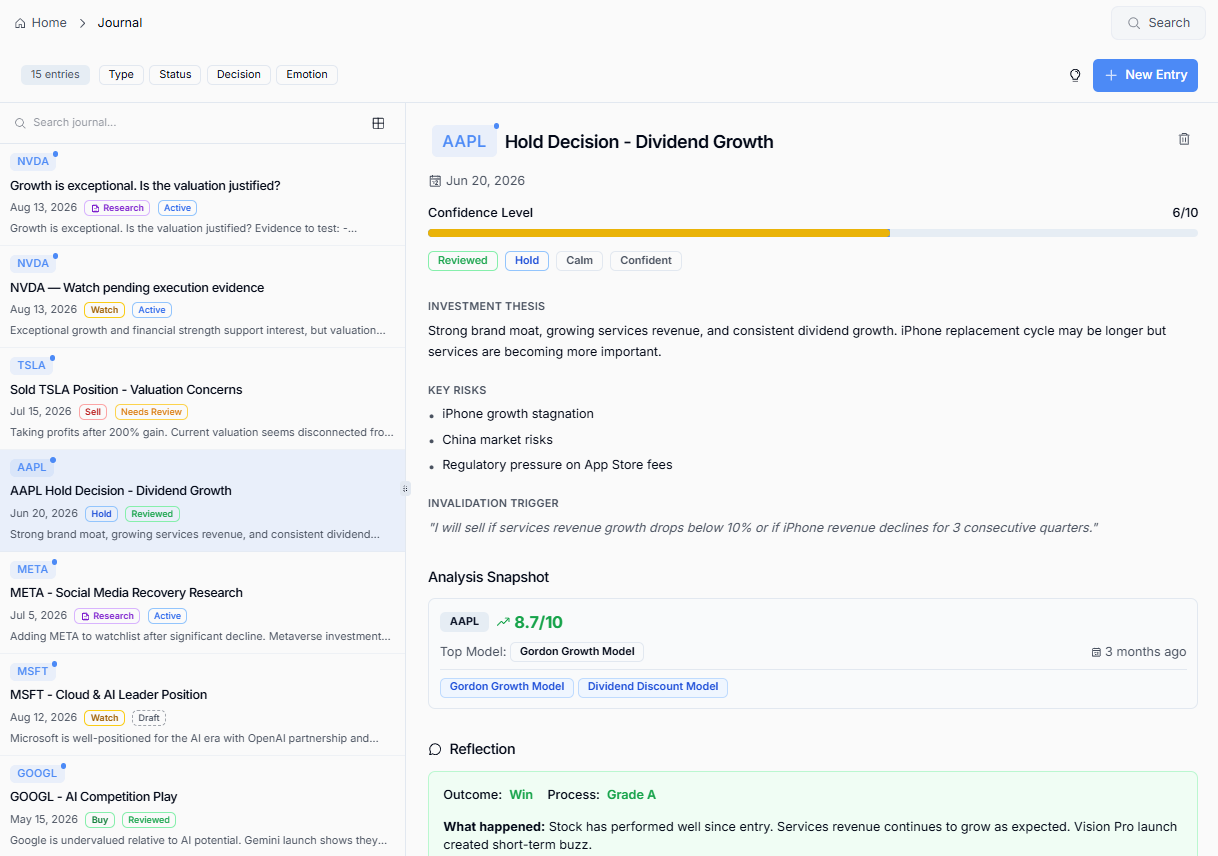
History & Journal
Keeps theses, risks, notes, decisions, and later reflections available as the investor’s view evolves.
Multiple investing lenses, not one universal score.
StockGeniuses uses 20+ investor-inspired models, each built to answer a different kind of question. Some focus on valuation, while others examine growth, income, financial resilience, momentum, sentiment, or business quality.
Taken together, they reveal where the evidence agrees, where it conflicts, and which assumptions carry the most weight in the thesis.
Value
Examines valuation, intrinsic value, earnings power, free cash flow, and margin of safety.
Growth
Looks at revenue and earnings growth, durability, quality, and the economics behind expansion.
Dividend
Reviews income quality, payout sustainability, dividend growth, and long-term consistency.
Financial Health & Risk
Assesses balance-sheet strength, distress risk, volatility, drawdowns, and financial resilience.
Momentum
Tracks price strength, trend, relative performance, and market confirmation.
Sentiment
Summarizes news tone, analyst context, and shifts in market perception.
Models are lenses, not verdicts.
A model organizes evidence around a particular investing question. The most useful reading comes from comparing several models, understanding where they disagree, and asking what would invalidate the thesis.
Portfolio analysis is descriptive, not prescriptive.
The Portfolio view is designed for reflection. It helps investors understand exposure, concentration, risk behavior, and how closely the holdings match the portfolio’s stated purpose.
It can reveal where risk is concentrated and how the portfolio has behaved under different conditions. Allocation changes, trades, and target weights remain the investor’s decision.
Monitoring mode
A factual view of current value, holdings, exposure, allocation, performance behavior, and changes that may warrant attention.
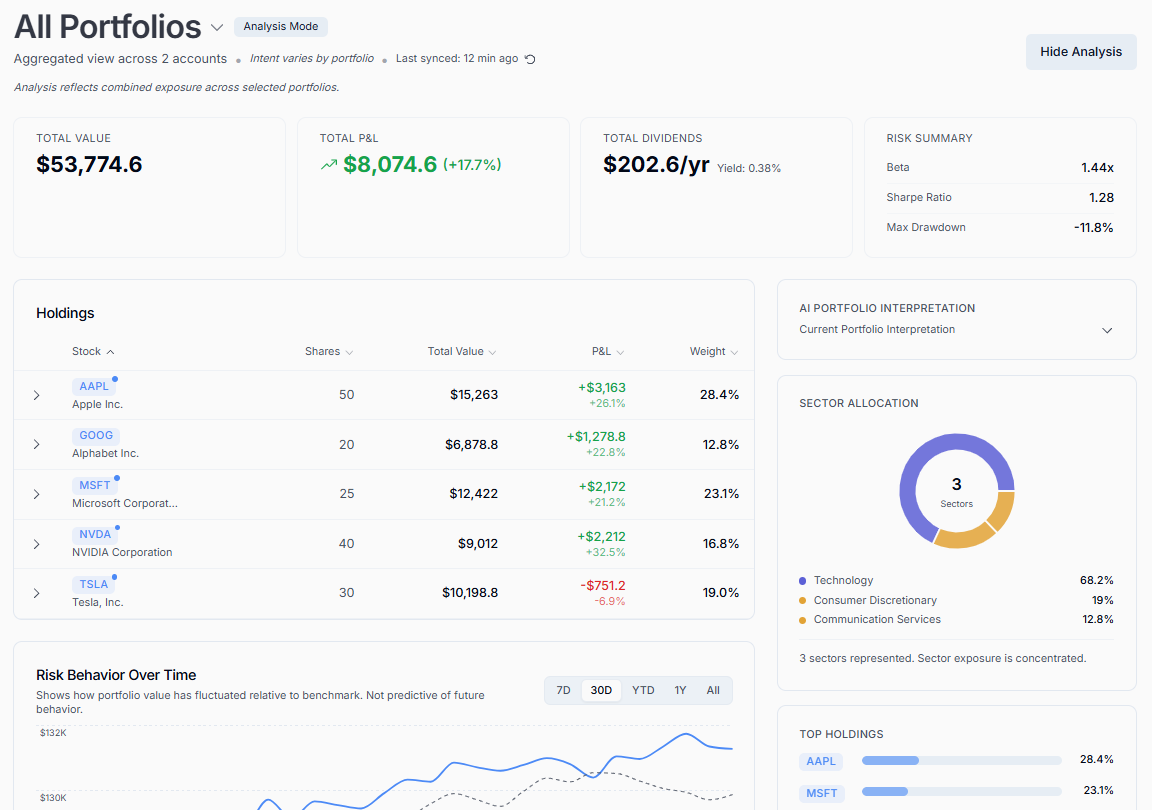
Analysis mode
A deeper view of concentration, sector exposure, risk behavior, and alignment with the portfolio’s stated intent.
AI explains. You decide.
AI translates structured outputs into language that is easier to work with. It summarizes visible information, surfaces tradeoffs, and helps connect new evidence with the existing thesis.
Its role ends at explanation. Judgment and action remain with the investor.
Explaining model outputs
Translates structured results into plain-English interpretation.
Summarizing context
Connects relevant data points, signals, and model findings.
Clarifying tradeoffs
Shows strengths, weaknesses, uncertainty, and conflicting evidence.
Supporting reflection
Helps compare the original thesis with later outcomes and observations.
Signals show what changed. Analysis explores what it may mean. The decision stays with you.
These layers are deliberately separate, giving the investor room to examine new information before deciding whether it changes the thesis.
01
Signals
What changed?
Highlights movement, new information, or a threshold worth examining.
02
Analysis
What might it mean?
Adds model context, tradeoffs, uncertainty, and the evidence behind the change.
03
Decision
What do you believe?
Records how the change affects the thesis, risks, invalidation points, and timing of the next review.
Built for publicly traded equity stocks.
StockGeniuses currently focuses on publicly traded companies. Its models and workflows are built around business fundamentals, financial statements, market data, ticker-level history, and portfolio exposure.
Crypto, commodities, bonds, forex, options, and other security classes fall outside the current product scope.
Supported now
- publicly traded equity stocks
- stock discovery
- stock analysis
- watchlists
- portfolios
- signals
- decision journal
- research notes
- ticker-level context
Outside the current scope
- crypto
- commodities
- bonds
- forex
- options
- other security classes
Clear boundaries matter.
StockGeniuses is a research and decision-support platform. Model outputs, AI explanations, signals, portfolio views, and journal entries are inputs for the investor’s own work.
The platform does not provide personalized financial advice, execute trades, recommend reallocations, or guarantee outcomes. Investing decisions—and responsibility for them—remain with the user.
StockGeniuses does not provide:
- Personalized buy/sell instructions
- Trade or reallocation recommendations
- Portfolio optimization
- Return guarantees
- Certain market predictions
- A substitute for independent research or professional advice
Bring a consistent method to every stock you research.
StockGeniuses keeps models, AI explanations, ticker history, signals, portfolio context, watchlists, and journal entries connected—so the original thesis remains visible as new information arrives.